Many people overlook an important fact: a significant portion of the wood harvested in India each year is not used for construction, temples, or other expected purposes. It’s going into furniture. Wardrobes, cabinets, bed frames, office desks- the everyday stuff that fills our homes and workplaces is quietly one of the bigger reasons trees keep coming down.
That’s starting to change, and not because of some sweeping government mandate or a sudden change of heart across the furniture industry. It’s changing because of a fairly unglamorous material that’s been sitting in plain sight for years: agro-waste particleboard.
Why Timber Demand Became a Forest Problem
India’s relationship with wood has always been a bit strained. Forest cover has been shrinking for decades, even as construction, real estate, and furniture demand keep climbing along with a growing population and rising incomes. More people buying homes means more people buying furniture, and for a long time, “furniture” meant “wood”.
The trouble is, trees take decades to grow and seconds to cut. A sal or teak tree used for a dining table might have taken 40, 50, 60 years to reach a usable size. Furniture doesn’t wait that long, and neither does the market. So the gap between how fast timber is consumed and how fast it can regenerate has been widening for years, and forests have paid the price.
Add to that the fact that natural forests do far more than supply wood — they regulate rainfall, hold soil in place, support biodiversity, and act as one of the country’s few natural buffers against extreme heat. Cutting them down for furniture that could, in many cases, be made from something else entirely starts to look like a fairly bad trade.
Enter the Farm
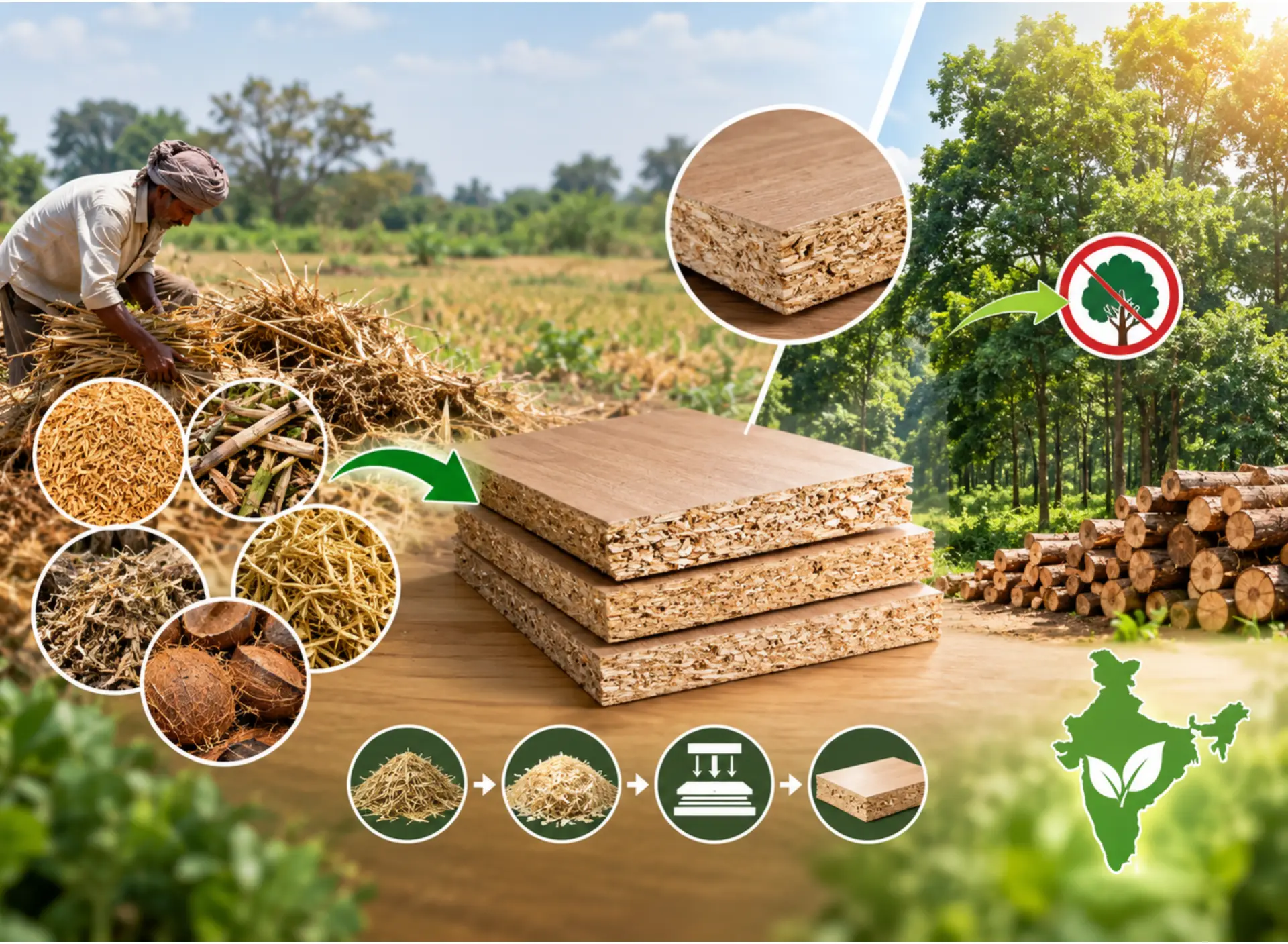
Here’s where it gets interesting. India also produces an almost unbelievable volume of crop residue every year: rice husk, wheat straw, sugarcane bagasse, and more.Traditionally, much of this residue has been burned in fields after harvest, partly because farmers have few options for disposal.
That burning isn’t a small side issue. It’s a major contributor to the toxic air that blankets large parts of northern India every winter, particularly around Delhi and the surrounding states. So for years, India has had two problems running in parallel: not enough sustainable wood supply, and too much crop waste with nowhere useful to go.
Agro-waste particleboard is essentially what happens when someone looks at those two problems side by side and asks an obvious question: what if the solution to one is the answer to the other?
From Field to Furniture, Minus the Forest
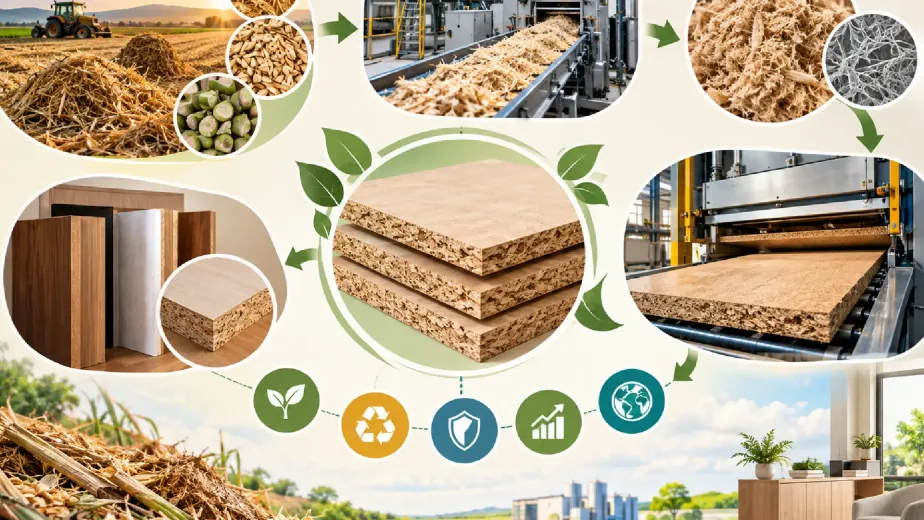
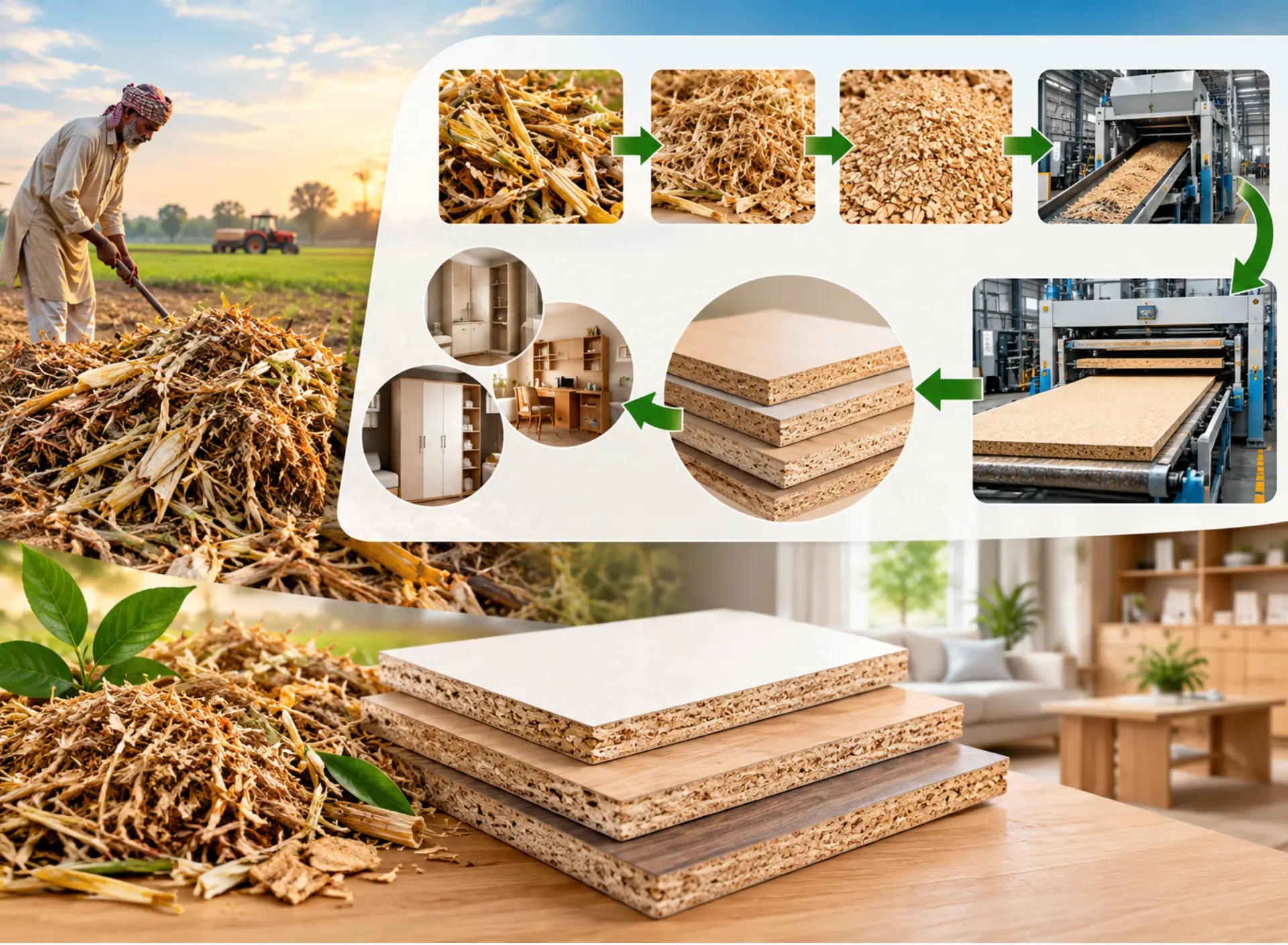
The manufacturing process takes that leftover crop residue, processes it into fine particles, binds it with resin, and presses it into solid, usable board, often built in three layers so the surface stays smooth while the core stays strong. What comes out the other end behaves a lot like conventional wood-based board. It cuts, drills, laminates, and holds screws the same way plywood or timber does.
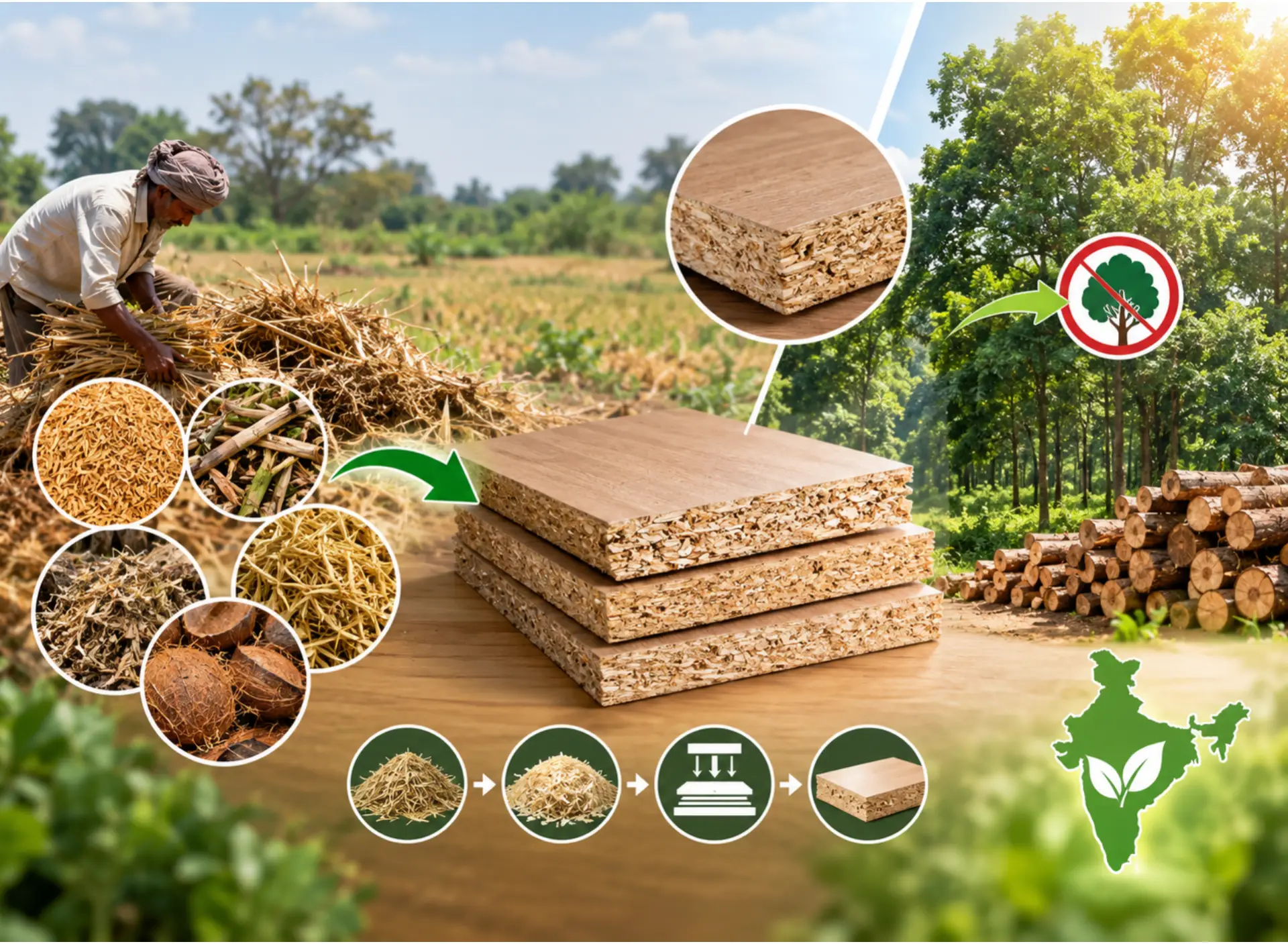
The difference is where it came from. Instead of a tree that took half a century to grow, the raw material came from a harvest that happens every single year. No forest had to be touched to make it.
When scaled up, the impact of this shift is far greater than it first appears. A manufacturing facility producing in the range of a lakh cubic metres of board annually is replacing what would otherwise be a genuinely significant amount of timber demand that would have had to come from somewhere, and that somewhere is almost always a forest.
The Ripple Effects Nobody Talks About
Fewer trees cut down is the headline, but it’s not the only benefit tucked into this shift.
Farmers get a use for material they’d otherwise burn or throw away, turning what used to be waste or worse, pollution into something with actual commercial value. That’s not a huge windfall for any single farmer, but at a national scale, it adds up to a meaningful shift in how crop residue is handled.
Air quality gets a quiet assist too. Every tonne of agricultural residue that goes into a particleboard factory instead of a bonfire in a field is a tonne that isn’t adding to the smoke problem choking northern Indian cities each winter.
And builders, architects, and furniture makers get a material that doesn’t force them to choose between doing right by the environment and staying within budget. Agro-waste board tends to be priced more competitively than premium timber, largely because the raw material itself doesn’t carry the same cost or scarcity.
Is It Really as Good as Timber?
Fair question, and worth being honest about. Agro-waste particleboard isn’t trying to be a like-for-like replacement for solid hardwood in every single application; nobody’s claiming you should build a load-bearing structural beam out of it. But for the overwhelming majority of furniture and interior applications- cabinets, wardrobes, shelving, modular kitchens, office furniture- it holds up perfectly well, and often outperforms natural wood in one important way: consistency. No knots, no warping from uneven grain, no piece-to-piece variation that natural timber is prone to.
Three-layer construction in particular has closed a lot of the gap that used to exist between engineered board and solid wood in terms of strength and finish. What you’re giving up, if anything, is a bit of the “character” that comes with natural wood grain, and even that’s addressed to a large extent through lamination and veneer finishes that replicate the look people want.
Why This Is Bigger Than One Product
There is a broader pattern emerging, and India is not alone in this. Around the world, industries are slowly figuring out that a lot of what used to be treated as waste can actually be turned into something useful, cutting down on both raw material extraction and disposal problems at the same time. Agro-waste particleboard just happens to be one of the clearest, most successful examples of that idea actually working at scale.
It also lines up well with where construction and interior design are headed. Green building certifications increasingly reward the use of materials with a lower environmental footprint, and architects working on eco-conscious projects are actively on the lookout for exactly this kind of alternative to virgin timber.
The Bottom Line
None of this means every tree in India is suddenly safe. Deforestation is a complicated problem with a lot of moving parts, and furniture is only one piece of it. But it’s a genuinely significant piece, and agro-waste particleboard is quietly chipping away at it, one factory, one harvest season, one piece of furniture at a time.
The next time you buy a wardrobe or get a kitchen redone, it’s worth asking what the cabinets are actually made of. There’s a decent chance the answer involves a farm rather than a forest, and that’s a trade worth knowing about.