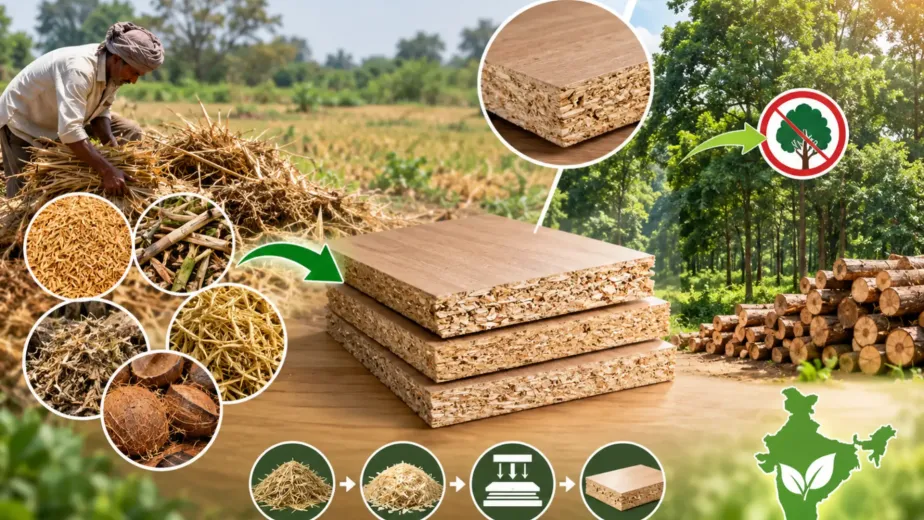
Here’s something most people never think about: that wardrobe panel you’re leaning against right now had a previous life. Before it became flat, finished, and fixed into a frame, it was probably rice husk or sugarcane waste sitting in a field somewhere, with no clear use for it.Most people never stop to think about that journey while choosing laminate colours at a furniture store—and honestly, why would they? But it’s a genuinely interesting story, so let’s walk through it.
It Starts With Something Nobody Wanted
Every harvest season leaves behind a mountain of leftover material: husk, straw, bagasse, or whatever the local crop produces in surplus. For a long time, farmers didn’t have many good options for this stuff. A lot of it got burnt right there in the field, which is a big part of why this process matters in the first place.
When this residue arrives at a manufacturing plant, it doesn’t just get thrown straight into production. Trucks are weighed, loads are inspected, and any material deemed too wet, too dirty, or contaminated with inappropriate debris is rejected immediately. Quality control, it turns out, starts long before the material ever touches a machine.
Mixing in the Resin
Now the particles need something to hold them together, and that’s where resin comes in. This step is trickier than people assume. Too little resin and the board falls apart under normal use. Too much, and beyond wasting material, you’re pushing formaldehyde emissions higher than they should be. A real concern for indoor air quality once the board is installed in someone’s bedroom or kitchen.
At facilities handling serious volumes—often around a lakh cubic metres a year—this blending process isn’t left to guesswork or manual mixing. Automated systems handle it, because achieving consistent results across thousands of tonnes of material by eye simply isn’t realistic.

Why Layers Matter
Instead of pressing everything into one uniform slab, better manufacturers build the board in three separate layers, each doing a different job.
The two outer layers use finer particles. These become the surface: smooth, workable, and ready to take lamination or veneer without a fight. Sandwiched in the middle is a layer of coarser material, and this is the one actually holding the weight. It’s the part doing the structural heavy lifting while the outer layers focus purely on finish.
Think of it less like a single block of material and more like a team where everyone has a specific job. The middle handles strength. The outside handles appearance. Neither one could do the other’s job particularly well on its own.
Heat, Pressure, and a Bit of Drama
Once layered, the material heads into a hot press, and this is where things actually get physical. Intense heat and enormous pressure force the resin to cure and the particles to fuse into a single solid piece. It only takes a few minutes per batch, but the temperature, pressure, and timing are all watched closely, because even small deviations here change how dense, strong, or finished the final board turns out.
What comes out afterwards barely resembles the loose residue that went in. It’s rigid, flat, and dense enough to be drilled, cut, screwed, and laminated the same way ordinary wood panels are.

The Final Checks
Freshly pressed boards get trimmed to standard sizes and sanded down. A lot of the real quality control happens right here: checking density, moisture levels, thickness, and surface finish before anything ships out. If a board doesn’t meet spec, it gets pulled at this point, not after a customer’s already installed it.
For boards going the pre-laminated route, one more step happens here: a decorative, protective surface layer gets bonded on under its own round of heat and pressure. What leaves the factory after this is ready to install – no extra finishing is required.
Why this matter?
There’s a reason to care about all this beyond simple curiosity. A board that’s gone through properly controlled drying, balanced resin mixing, careful layering, and precise pressing is going to hold up in your home for years. A board that’s rushed through a sloppier process might look identical on day one, but it won’t behave the same way after a couple of humid monsoons or a few years of daily use.
The same raw material can lead to wildly different outcomes, and the process is what truly makes the difference.
From Field to Furniture
There’s something quietly satisfying about tracing a cabinet panel all the way back to a farm field, knowing it began as material that might otherwise have gone up in smoke. Drying, blending, layering, and pressing—none of it is flashy, but together, these processes transform near-worthless crop residue into something strong enough to support the demands of daily life for years.
So, the next time you close a wardrobe door or lean on a kitchen counter, it’s worth remembering that there’s a surprisingly involved journey behind that ordinary-looking board—one that began on a farm and ended up becoming part of your home.