
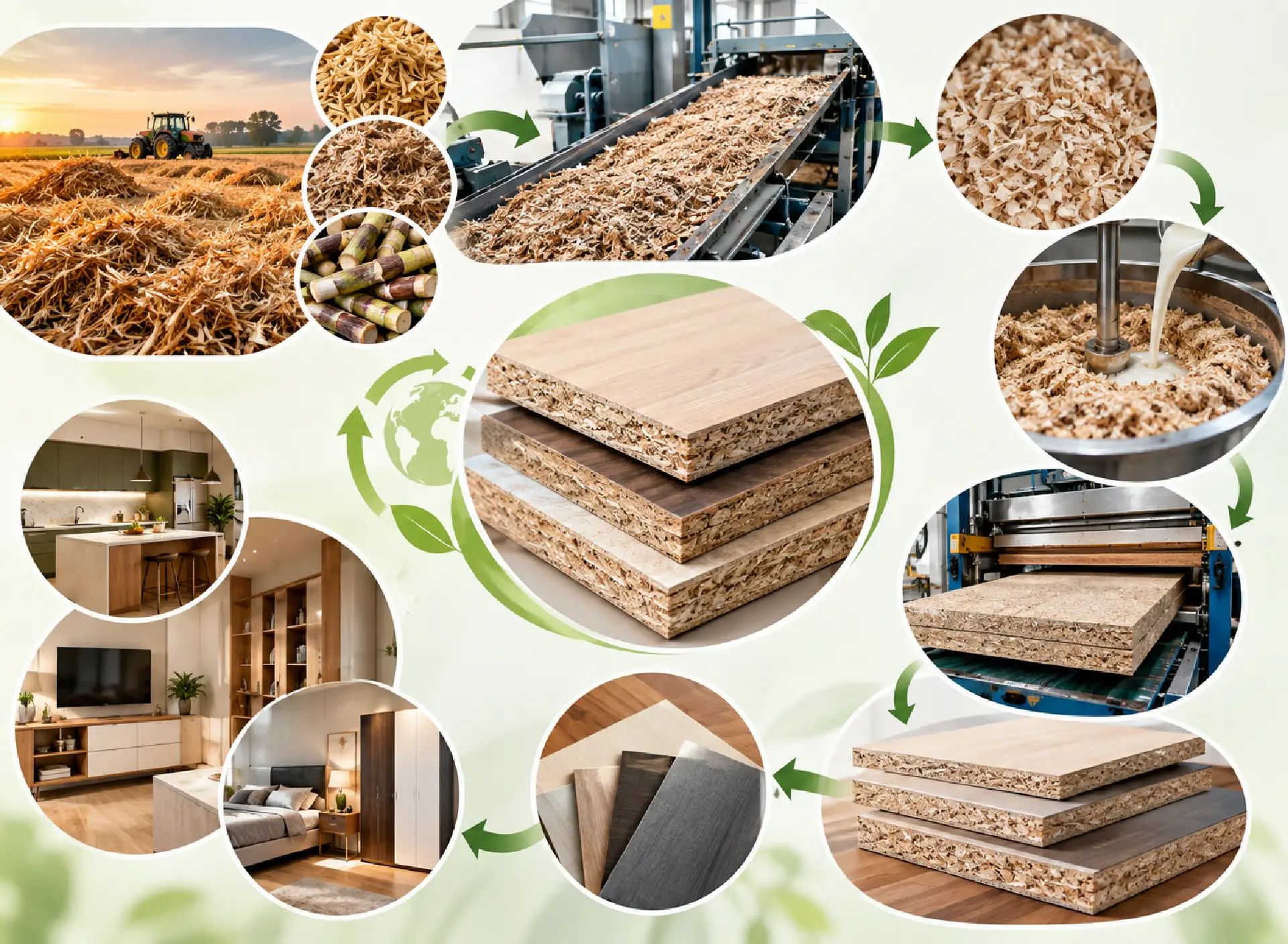
Walk into any furniture showroom today, and you’ll notice something quietly remarkable. That sleek wardrobe, the modular kitchen cabinet, the study table your kids do homework on—there’s a good chance none of it came from a tree that was cut down for the purpose. Instead, it began its life as wheat straw, rice husk, or sugarcane bagasse sitting in a farmer’s field, destined to be burned or discarded.
This shift isn’t a small industry footnote. It’s one of the more interesting transformations happening in Indian manufacturing right now, and it’s changing the way we think about the furniture inside our homes.
The Problem Nobody Talks About
Every harvest season, Indian farms generate an enormous volume of crop residue. Traditionally, a large share of this agro-waste has been burned in the fields- a practice that contributes heavily to air pollution across northern India every winter. The smoke that blankets cities like Delhi each October and November isn’t just bad optics; it’s a genuine public health crisis, and stubble burning is one of its biggest contributors.
At the same time, India’s furniture and construction industries have leaned heavily on timber for decades, putting pressure on forests that are already shrinking. So you have two problems sitting side by side: too much crop waste with nowhere useful to go, and too much demand for wood that the country can’t sustainably supply.
Agro-waste particleboard is one of the more elegant answers to both problems at once.
How Farm Residue Becomes Furniture-Grade Board
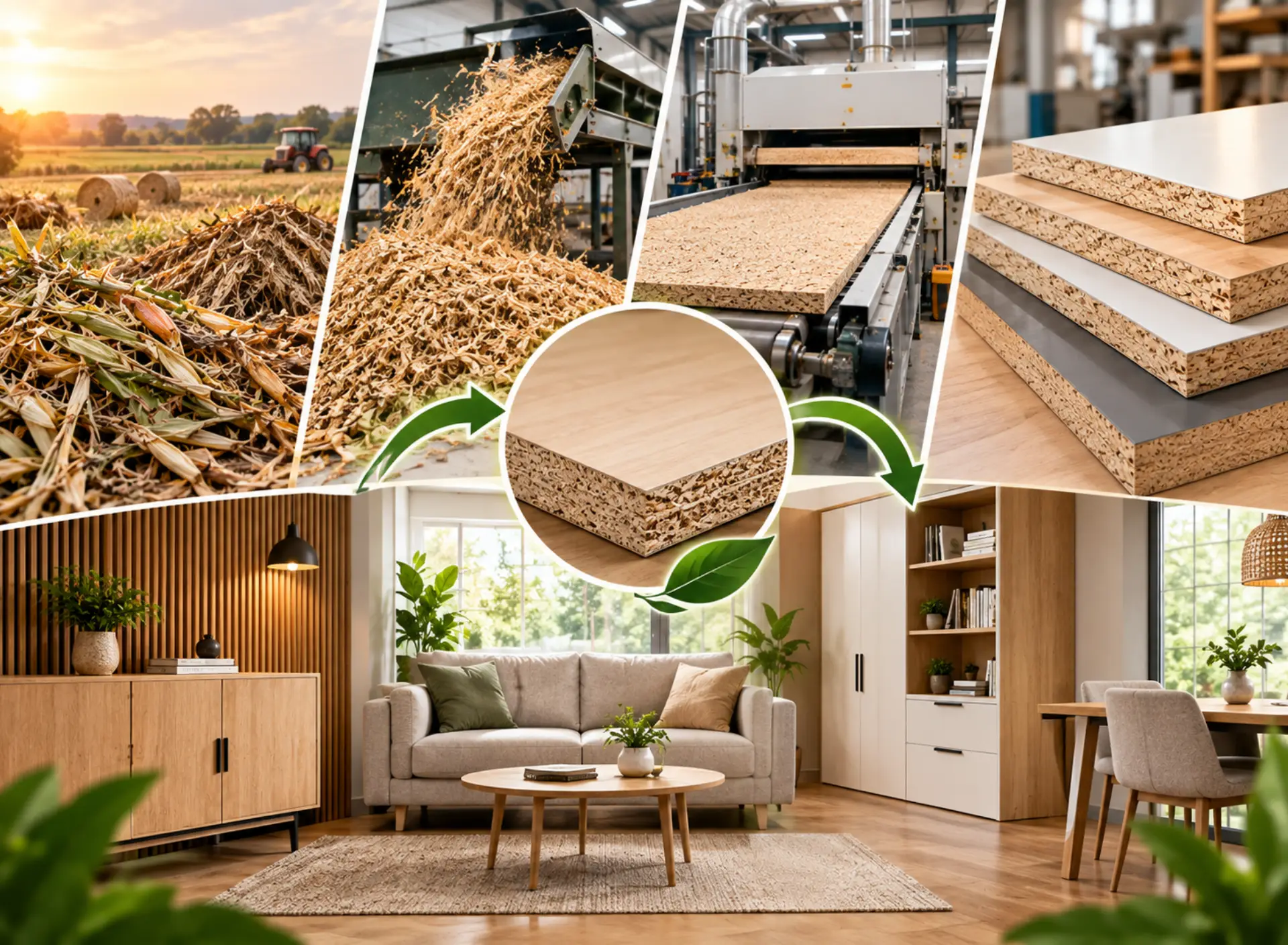
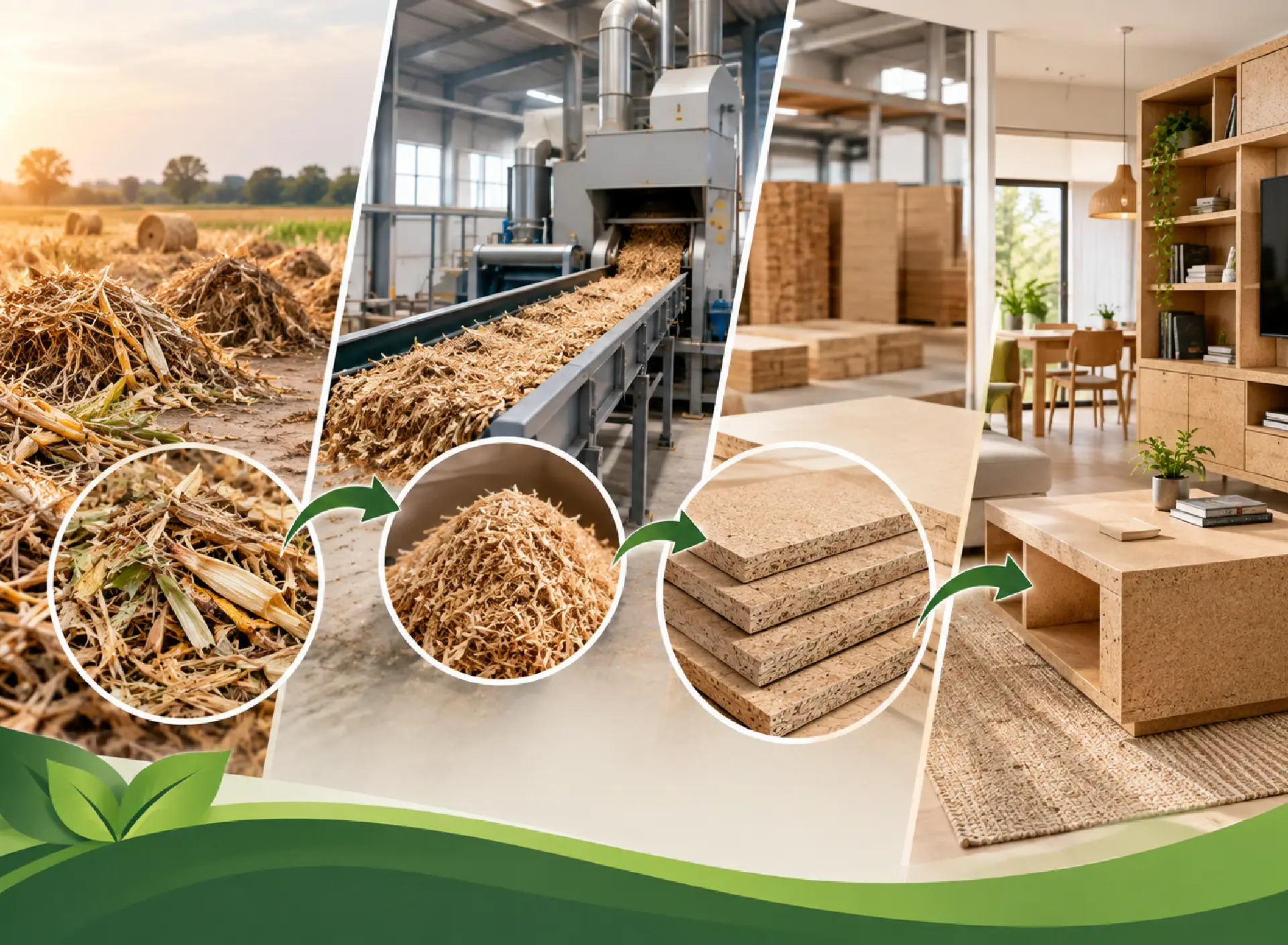
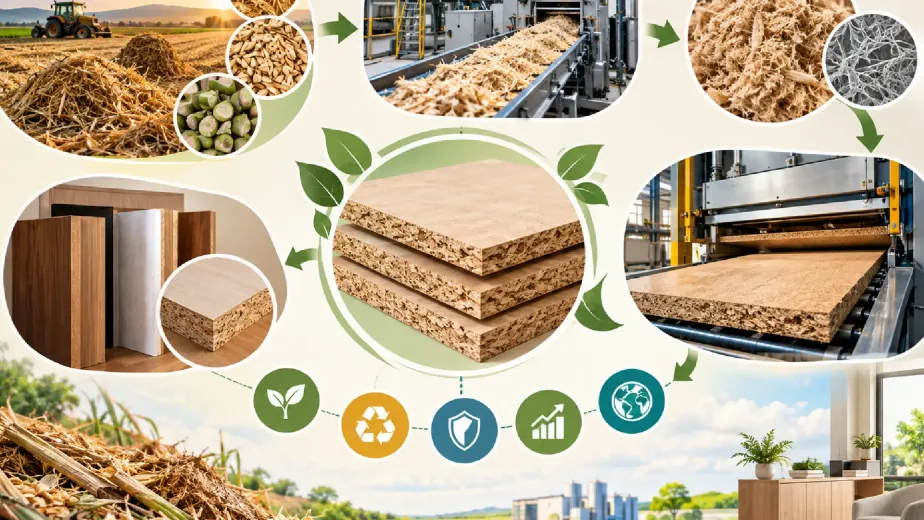
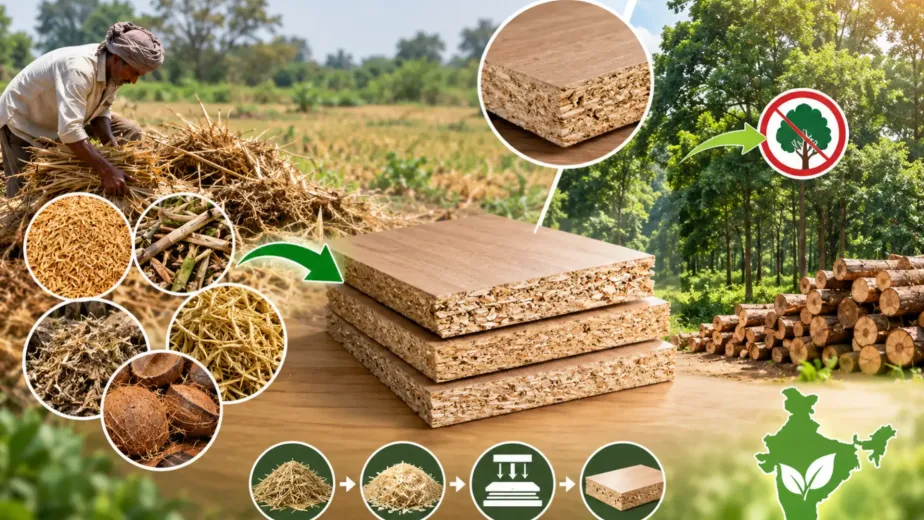
Here’s the part that surprises most people: the process isn’t nearly as complicated as it sounds. Crop residue gets collected from farms, cleaned up, and broken down into tiny particles. Nothing more exotic than that at the start. From there, those particles are mixed with resin and pushed through heat and pressure until they come out as a flat, dense board.
Most manufacturers build this in three layers rather than one solid slab. Why bother? Because the outer layers use finer, more refined particles that give you a smoother surface to work with, while the middle layer is packed with coarser material that does the heavy lifting on strength. Think of it a bit like a sandwich: the bread matters for how it looks and feels, but the filling is what actually holds everything together.
The result looks and behaves remarkably like conventional wood-based board. It can be cut, drilled, laminated, painted, or veneered just like plywood or timber. But instead of consuming forest wood, it repurposes something that would otherwise be waste or worse, a source of pollution.
Manufacturing plants producing at scale, some with capacities running into lakhs of cubic metres a year, have shown this isn’t a boutique or experimental process anymore. It’s a mainstream manufacturing category with real industrial output.
Why This Matters for Homeowners
For the average person shopping for furniture, the appeal isn’t purely about environmental virtue, though that matters more to today’s buyers than it used to. There are practical reasons agro-waste boards are winning over architects, interior designers, and homeowners alike.
Consistency. Natural wood varies piece to piece, with knots, grain irregularities, and moisture-related warping. Engineered board made from processed agro-waste particles is far more uniform, which makes it easier to work with for modular furniture, cabinetry, and flat-pack designs.
Cost efficiency. Because the raw material doesn’t carry the cost premium of harvested timber, agro-waste boards tend to be considerably more affordable, without a major compromise on strength or finish quality, especially in three-layer constructions designed for load-bearing use.
Design flexibility. Pre-laminated variants come finished and ready to use, cutting down on additional painting or veneering work. This has made them a favourite for kitchen cabinets, wardrobes, office furniture, and modular interior projects where speed and finish matter.
A genuinely lower environmental footprint. Every cubic metre of board made from crop residue is a cubic metre that didn’t require felling a tree. For a country facing both deforestation pressure and a farm-waste disposal problem, this is about as close to a win-win as manufacturing gets.
A Trend That's Bigger Than One Product Category
This isn’t happening in isolation. Circular manufacturing, the idea of turning what used to be considered waste into a valuable input for something else, is gaining ground across multiple industries in India, from packaging to construction materials. Agro-waste particleboard happens to be one of the most visible and successful examples of this idea in action.
It also lines up neatly with where interior design is heading more broadly. Homebuyers today are asking more questions about where their materials come from, not just how they look. Builders and architects working toward green building certifications are actively seeking out materials with a lower environmental impact, and agro-waste boards fit that requirement well.
There’s also a quiet economic story here. Turning crop residue into a marketable industrial input creates an additional revenue stream tied to agricultural waste that would otherwise have zero value or a negative one, given the pollution and health costs associated with burning it.
What to Look for When Choosing Agro-Waste Board
If you’re planning a renovation or a new furniture project, here’s what actually matters when you’re picking the board:
Start with how it’s layered. A three-layer board is going to hold up better and look smoother than a single-layer one, especially if it’s going into something people will lean on, stack things on, or slam shut a hundred times a year- think kitchen cabinets or a kid’s study table.
Then there’s moisture. If the board is headed for a kitchen, a bathroom, or just a house in a humid part of the country, don’t skip this step; ask specifically about moisture resistance. It’s the difference between furniture that lasts a decade and furniture that swells and warps within a year of monsoon season.
Finish is really a matter of how much time you have. Plain board leaves you free to laminate or veneer however you like, which is great if you’ve got a specific look in mind. Pre-laminated board is the shortcut; it shows up ready to install, no extra finishing step required.
And don’t overlook where the board is actually coming from. A board made by an established manufacturer running proper large-scale production tends to be more consistent, with fewer weak spots and fewer surprises than something turned out by a smaller, less standardised setup.
The Bigger Picture
Most of us never think twice about the material sitting behind the paint or laminate on our furniture. Fair enough, it’s not exactly dinner-table conversation. But there’s something worth pausing on here. Choosing agro-waste board over conventional timber isn’t just a manufacturing tweak; it takes pressure off forests, puts farm waste to genuine use instead of letting it go up in smoke, and still gets you furniture that’s strong, good-looking, and priced reasonably.
So next time you’re picking out furniture or planning a renovation, it’s worth asking a simple question: where did this board actually come from? More often than not these days, the honest answer isn’t a forest at all. It’s a farm.

1 Comment
lrlc8
dff
Comments are closed.